

What’s on our shelves: An accounting database style guide, the making of evil, and a trip to Porpoise Spit…
Last updated on: 29th January 2026|29th January 2026 | Open Fifth | WOOSH
Style Guide: TIGER_STYLE.md by Joran Greef, TigerBeetle contributors
TIGER_STYLE.md is the style guide for the design and programming of TigerBeetle, a financial accounting database written in Zig. While this sounds like a very funless document, it’s actually an enjoyable and lighthearted read with lots of interesting insight. We find phrases like “biodigital jazz” used to describe programming; an allusion to the idea that code is written principally for the consumption of compilers, but with its actual form and layout chosen creatively for the benefit of human readers and co-authors. “A tight beat and a rare groove”.
I am a lowly operations womble. The code I write runs only about as frequently as a kettle is boiled, and is evaluated for its correctness of output and lack of propensity to damage things. Reading this document helped me contemplate the attitude to performance required when, instead, your code runs once for every payment processed by a major bank. In the second half of the file, discussed are the topics “variable naming conventions”, “cache invalidation” and “off-by-one error mitigation” in reference to Phil Karlton’s truism:
“There are only two hard things in Computer Science: cache invalidation, naming things, and off-by-one errors.”
Giving serious thought to variable naming conventions in a guide like this, and emphasising to the reader how important they are, is interesting to me. Variable names have absolutely no bearing on the functionality of the final system, but potentially have a huge effect on the mental model you and your co-authors will have of the system as it is written. The concession that computer systems are ultimately still human endeavours is valuable I think.
Another thing emphasised is that time spent in design is worth more than time spent in implementation, and time spent in implementation is worth more than time spent fixing stuff in production. This idea is not groundbreaking, but it’s heartening to see it formalised.
Referenced early in the guide is NASA’s The Power of Ten – Rules for Developing Safety Critical Code, another surprisingly engaging technical document which among other things forbids all recursion, unbounded loops, pointers to pointers, and any/all runtime memory allocation. This is all very refreshing. When presented with a problem and a computer with which to solve it, the possibilities seem endless. Guidelines like these ground us in the reality that almost all of those possibilities were bad ideas from the get-go.
Jake Bateman, Linux System Administrator – Open Fifth
Board game: Flip 7 designed by Eric Olsen
Published in English by The Op Games (editions in other languages also available).
I don’t usually write about trendy games; I just write about games I like! But for once, as everybody seems to be playing Flip 7, I am writing about Flip 7.
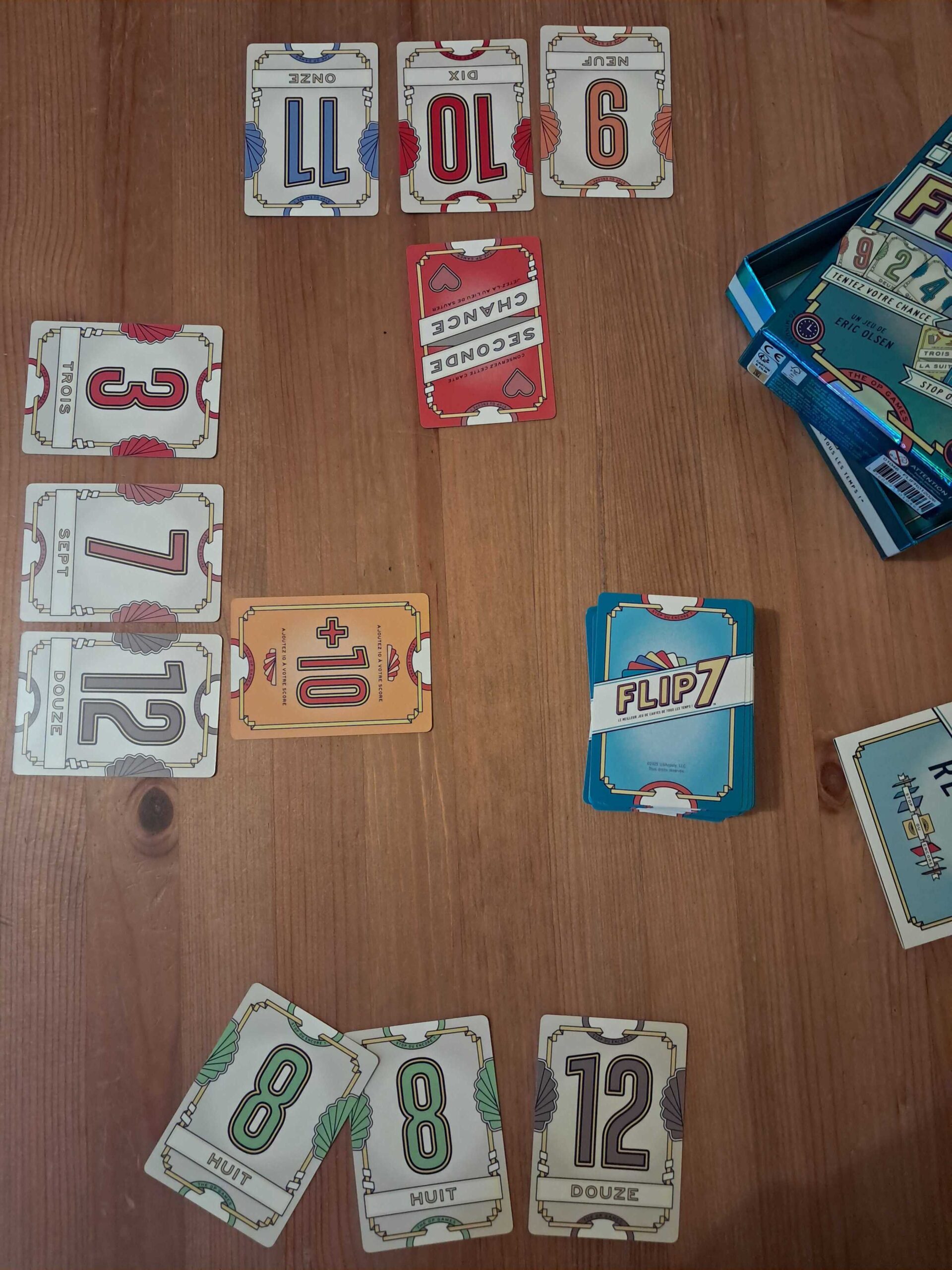
Flip 7 is the push-your-luck card game every French household got a copy of for Christmas. Or so I assume, because when my parents looked to buy their own copy on Saturday 27th December (so they could play it with friends the next day), they found the game was completely out of stock with its distributor! (They checked with no less than 5 shops in their local area before they eventually found a copy.)
Flip 7 is the sort of game you want to play while waiting for dinner to finish cooking, or to round off a good evening. When it’s your turn, you decide whether to get a new card from the deck. If that card has the same value as one of the cards already in front of you, you’re bust; you don’t score points for that round. If you choose to stop before you’re bust, you earn the points from the cards in front of you. The game ends when a player’s score adds up to over 200, and whoever has the most points wins. There are also some special cards; and, as the name suggests, a bonus if you flip 7 cards without going bust.
So, are you going to go for another card or not? You really should…
Aude Charillon, Customer Services Consultant – Open Fifth
The great January podcast cull by Val Skelton
Over the Christmas break I decided to do some light, non-judgemental auditing of my media consumption habits, starting with my podcast subscriptions. I discovered that I was (embarrassingly), subscribed to seventeen true crime podcasts. I culled all but one of these, keeping Criminal (which despite its name is really a storytelling channel, presented by the best voice in podcasting, Phoebe Judge).
Then I moved on to my ‘learn Latin’ podcasts and unsubscribed from those as well. Who would have thought that attempting to learn Latin, using charity shop textbooks and a free Duolingo account would have proved so difficult? I’m afraid I must delay becoming a Latin scholar until I become the ward of a rich and eccentric distant relative who will hire a tweed-wearing tutor and test me every evening on the ablative.
After a few other rogue subscriptions were thrown out, here are some of the podcasts that survived the great cull:
- The British History Podcast (I am now at the year 468 – Season 2, episode 85, but still struggling to remember all the kings’ names)
- Several Goalhanger podcasts (including The Rest is Football, The Rest is Politics, The Rest is Entertainment)
- Radiolab – the first podcast I ever followed
- Kermode & Mayo’s Take
- Ear Hustle – stories of life inside California’s San Quentin State prison – a genuinely moving listening experience
- The Secret History of Hollywood
Turning to Reddit for advice and guidance, I was alerted to Poetry Unbound, presented by Pádraig Ó Tuama, who reads and discusses one poem every week and is a wonderful, unhurried companion on walks. Cerys Matthews, on her BBC Radio 6 Music Sunday morning show, mentioned As the Season Turns, a podcast describing and celebrating the changing seasonal landscape, released on the first of each month.
I am open to recommendations for interesting podcasts. I shall be listening to them while I move on to auditing and editing my YouTube subscriptions (I apparently follow over thirty-five US police body-cam and vehicle-chase channels).
Val Skelton, Administrator – Open Fifth
Film: Muriel’s Wedding by P. J. Hogan
I’ve read and watched my way through many great things this dreary January, most deserving of reviews, but today I’m WOOSHing over Muriel’s Wedding (1994), directed by P. J. Hogan.
I rewatched this within the last two years, but when my wife and I realised that my sister had never seen it, a watch-party with a foot spa and Thai food take-out was planned.
Muriel (Toni Collette) is tired of her life and belittling dad in Porpoise Spit, Australia, and when the opportunity arises to make it out of there she grabs it with both hands, a bucketful of lies, and a sprinkle of confetti.
Collette is outstanding in the title role (of course), and the script-writing and casting for her awful small-town “friends” is just perfect. It is a touching comedy with some scenes so awkward you have to grimace through them. I find myself always rooting for the terrible Muriel, and often wanting to shout at her. If you haven’t seen it before, or in a long while, it will brighten up these short, grey days.
And for the rest, I read:
The Well of Loneliness by Radclyffe Hall, For Thy Great Pain Have Mercy on My Little Pain by Victoria Mackenzie (a book club read), Dancer from the Dance by Andrew Holleran, The Very Heart of It: New York Diaries, 1983-1994 by Thomas Mallon, fascinating article ‘We Used to Read Things in This Country: The history of literacy is the history of class’ by Noah McCormack in The Baffler (issue no. 81), and currently halfway through The Portrait of a Lady by Henry James.
And watched:
A Safdie Brother(s) film fest: Marty Supreme, Uncut Gems, and Good Times, Josh O’Connor as a complex 1970s art thief in The Mastermind (2025) directed by Kelly Reichardt, and the impeccably attired Katharine Hepburn as a reference librarian facing replacement by the ‘big machine’ in Desk Set (1957) directed by Walter Lang.
(Giving up Reddit has given me far more time to read and watch, although I fear I have sacrificed things to talk about with Val and winning the banana-scrolling comparison at the end of year company meeting.)
Lauren Purton, Marketing Executive – Open Fifth
Books: Under the surface of Cambridge academics
On finishing two books this month I realised that by complete chance I have been reading two tales both centring around Cambridge academics and also both with the plot device of the surface concealing what is really going on.
Firstly, the lovely The Humans by Matt Haig. This is classic Haig and it was interesting to read in the afterword that it is a book he wrote well into his writing career even though he had wanted to get this story of grappling with what it means to be human and to fight for the other humans that you love written for many years. It is heart warming and a joy to read.
The second is, I suspect, lesser known and is a debut novel by James Cahill – Tiepolo Blue. This is a masterwork of academic, artistic, shimmering, languid and deeply unsettling proportions. The blue of the title is from the frescoes of the eponymous Old Master of the 18th century and just as our hero tries to use his academic and studied intellect to unlock and decode the mysteries of this painter’s masterpieces, so the author slowly strips away the veneers and varnishes of paintings, relationships, characters and propriety. However it seems that the closer our hero gets to the truths of the lives around him, and indeed to a truth to himself, the muddier, more fragmented and the more opaque those perpetual azure blue skies seem. It is a page turner, written in short diary-like style but at the same time deeply uncomfortable to read.
On a completely different tack but just as dense as Tiepolo Blue, Luna Wolf Moon by Ian McDonald is a sci-fi novel that packs a serious punch, literally and metaphorically. There is violence, sex, intrigue, politics, high fashion and family drama all woven into an intricate and rich tapestry. The in parts slightly alien language, the not too distant future, the totally imaginable technology and an almost attainable lunar location as well as the all too familiar theme of corrupt corporate power make this science fiction world seem worryingly, intriguingly and temptingly adjacent.
Andrew Auld, Commercial Director and Co-Owner – Open Fifth
Updates from Helen
Listened to:
Making Evil by Dr Julia Shaw
I almost listened to this in one go as I gave my house a huge clean after New Year’s Day. I had had the family up to celebrate New Year’s Eve and between the savage nephews and mad dog, I wanted to cleanse the place. Listening to Dr Julia Shaw break down whether or not she believes people are evil, people’s actions are evil, or whether or not we should even use the term evil was a fantastic accompaniment to my scrubbing.
I first learned about Dr Julia Shaw listening to the amazing podcast Bad People where she co-hosted with the comedian Sophie Hague and have sought out all of her books since. This one was just as good as the others. She explains each case or scenario very clearly then breaks down why, in her opinion, labelling a person or their actions as evil is neither productive nor accurate.
She makes a very compelling case that reducing everything down to being evil reduces the impact of the intention behind the word.
Language is really important and I often feel very frustrated by the terms used in the media and politics. I get very easily fatigued by that language and all the “click bait” trying to shock and influence me. I really appreciate someone arguing for more careful use of how we describe and talk about the terrible things that human beings do to one another.
Read:
The Book of Dust: The Rose Field by Philip Pullman
I loved the His Dark Materials series so I wanted to love this series. And I did thoroughly enjoy the first instalment, Le Belle Sauvage. I got totally confused and lost in the second, The Secret Commonwealth, but then I remember being a bit confused and wondering where it was all going to go and end up in The Subtle Knife and it was worth powering through because The Amber Spyglass wound things up amazingly.
The Rose Field just doesn’t manage that for the Book of Dust series. Maybe it’s because repeating the same themes just doesn’t have the same impact when the characters are adults as opposed to children. Maybe writing another series that has the same themes, with the same characters just doesn’t work, particularly when it was done so well the first time round. I read it. I didn’t hate it. I didn’t love it. It would not shock me in the least if there’s a fourth at some point.
Wolf Worm by T. Kingfisher
I’ve been on a mission to read all of Kingfisher’s books since I was recommended her by a friend last year. She has a superb ability to create characters and worlds that are incredibly engaging and real, even if they are based in horror or fantasy settings. I was lucky enough to get an advanced copy of Wolf Worm and it did not disappoint.
I’ve never been a fan of horror but between the Sworn Soldier series and Wolf Worm I’m finding a type of horror that I can thoroughly enjoy.
I could so easily see the characters in Wolf Worm. I could see the location; the big old American house in the countryside. I could see the painting of insects Sonia was creating for the book her employer had hired her for.
I worked in libraries and archives for many years so have handled many examples of the book and illustrations described so brilliantly. I also have a degree in biology, so the explanations of the insects were fascinating. Just gruesome enough to make me want to keep reading but not so gruesome to put me off. But then I may have a relatively high tolerance for that.
I loved it.
Helen Symington, Sales Executive – Open Fifth